What embedded finance means, why it matters for platforms, and how companies like Lyft use it today.
Embedded finance means offering a financial product – like a payment or loan – without being a financial institution yourself. The regulated infrastructure handles the compliance-heavy behind-the-scenes work for you, making it invisible to your customers.
For platforms, that's your opportunity. Every payment, payout, and financing option your customers use today already comes with a fee – it's just going to someone else. Embed it, and it's yours instead: platforms that adopt embedded finance are seeing revenue could grow up to 3-4x (Adyen and BCG's 2025-updated Embedded Finance Report).
Want in? Keep reading. This guide covers: what embedded finance is, the three layers behind it, how platforms are using embedded finance today.
What is embedded finance?
Embedded finance is a financial product delivered inside a non-financial company's platform, instead of through a bank or financial institution directly.
There's a very high chance that you've already experienced embedded finance as a customer. If you've had a 'pay in 4' option appear at checkout or been offered a credit card branded to a retailer or airline you shop with, then you've experienced embedded finance firsthand.
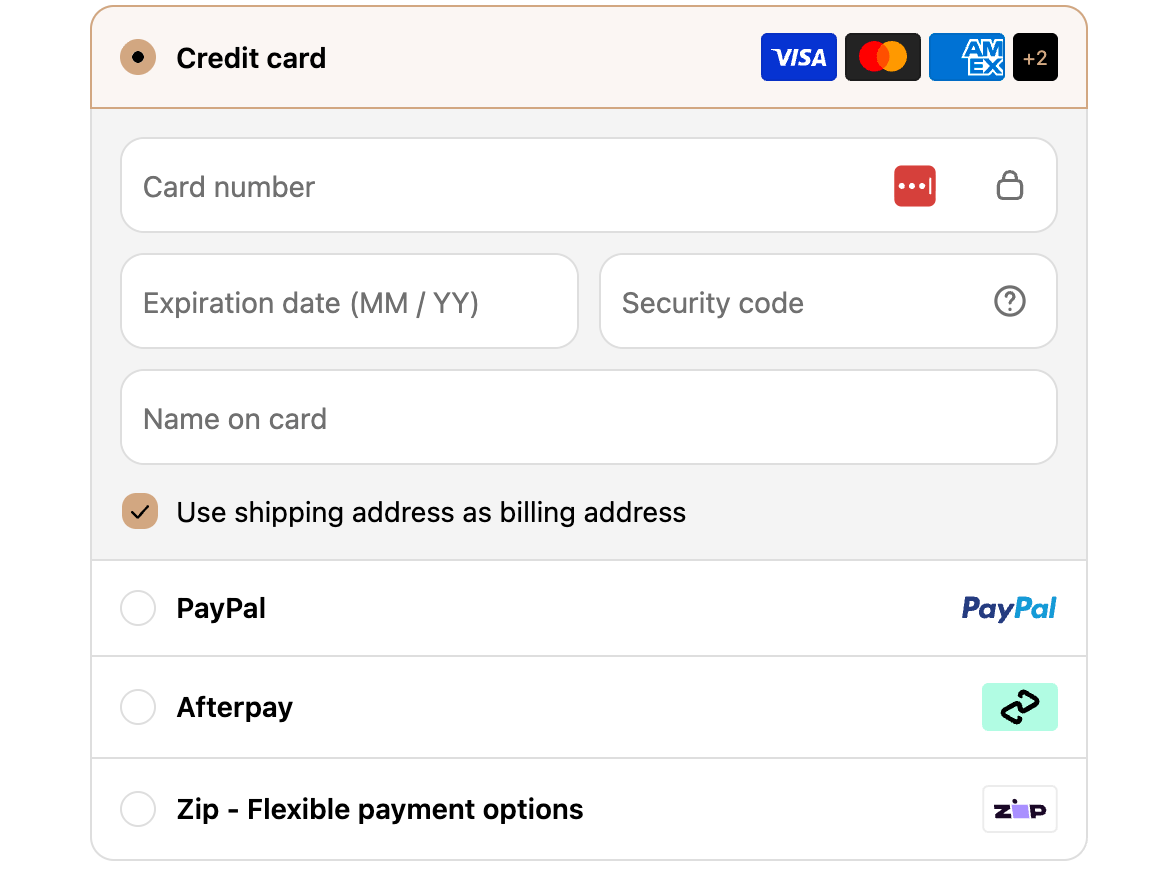
What makes this possible – non-financial institutions offering financial products – is that the non-financial company doesn't need its own banking license to offer the product.
Instead, it partners with a regulated financial institution that already holds a license, and borrows that infrastructure to deliver payments, lending, cards, insurance, and investment products directly inside its own app or website.
How new is embedded finance?
Embedded finance feels like a fintech-era invention, but the model is decades old.
In 1987, American Airlines partnered with Citibank to launch the AAdvantage credit card. American stayed an airline, while Citibank handled the lending and carried the regulatory risk behind it.
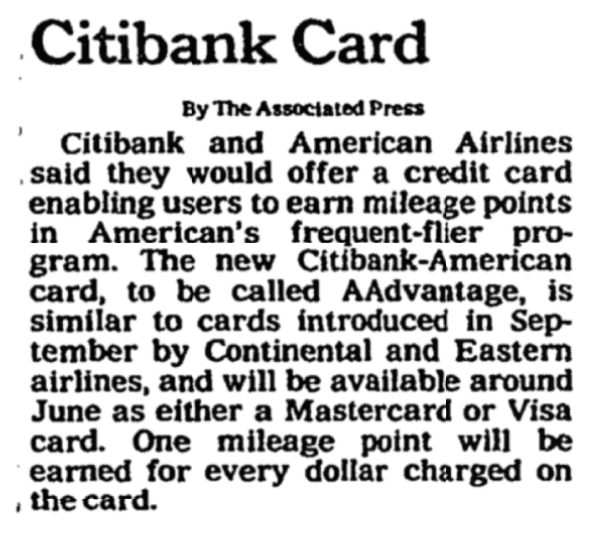
Almost 40 years later, the two companies are still partners.
As Hannah Duncan, a fintech and financial services writer, explains:
"The term 'embedded finance' was first coined by Matthew Harris in 2019. Harris was monitoring the exciting new financial technology that was soaring into the mainstream. He encouraged founders to “incorporate embedded financial services into their business models and tech stacks”. The name stuck. Since this time, embedded finance has evolved from a humble “one click” concept to a vast global ecosystem, affecting consumers everywhere."
- Hannah Duncan, Financial Journalist
The key difference between embedded finance and BaaS
Embedded finance is what is being delivered, and banking-as-a-service, aka BaaS, is how that product gets delivered. So while embedded finance is the financial product offered by a non-financial company, BaaS is the licensed infrastructure powering it behind the scenes.
Here's a real-world example: Lyft Direct offers drivers instant, no-fee access to their earnings after every ride – that's embedded finance. The infrastructure that lets Lyft offer this (Payfare's platform and Stride Bank's license) is BaaS.
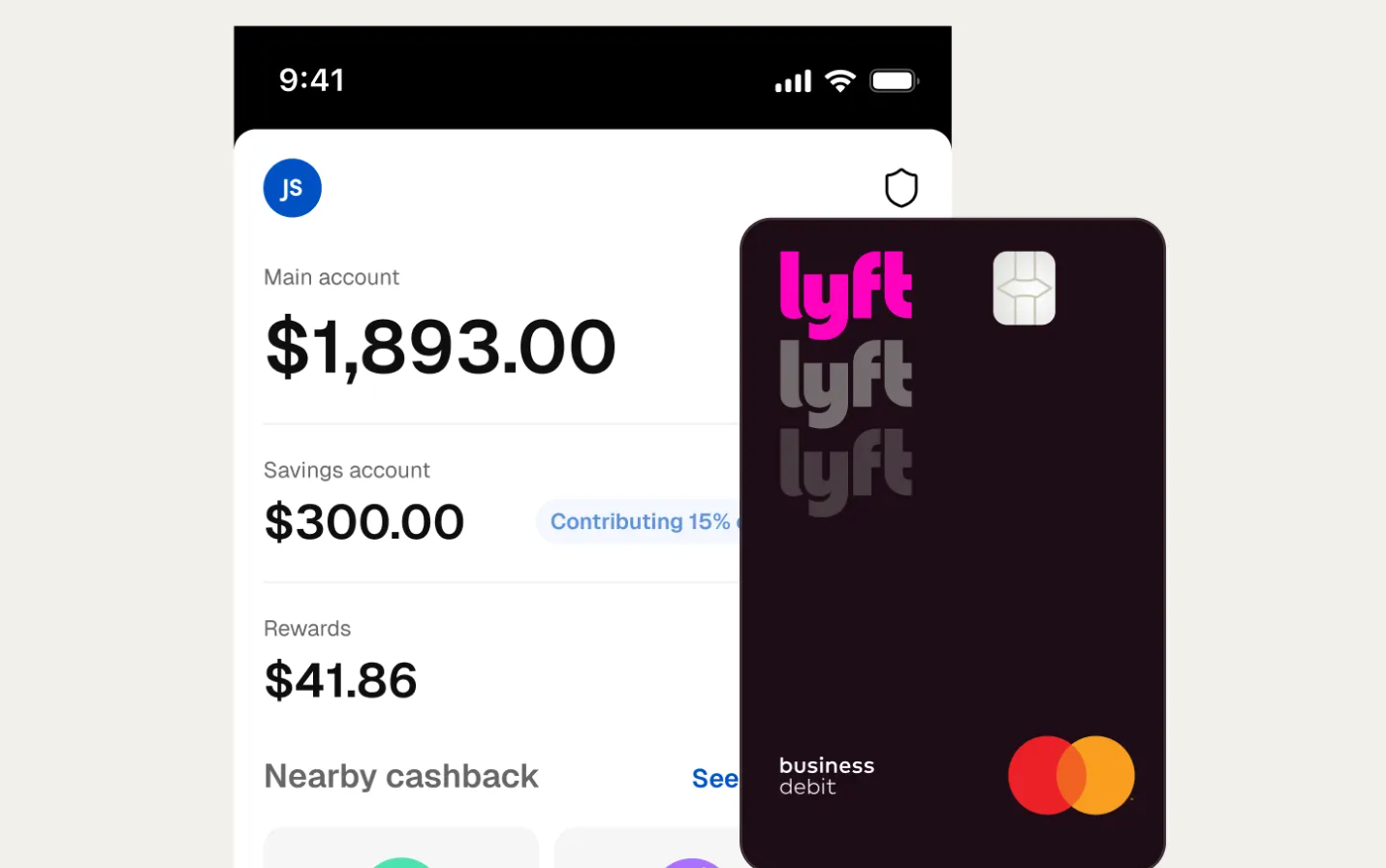
Now, an important distinction: not all embedded finance runs on BaaS – some are direct bank partnerships, like American Airlines and Citibank, with no API involved.
A direct bank partnership deal is custom-built and one-off, negotiated and built specifically between two companies, with no shared technology involved. BaaS exists to remove that need, so instead of a bank building a new custom integration every time, it builds its infrastructure once and exposes it through an API that any end-brand can plug into.
But while not all embedded finance runs on BaaS, all BaaS is a component of embedded finance, as BaaS only exists so a non-bank can offer a financial product. That's its whole purpose.
The three layers of embedded finance
There are three layers, or three key players, in embedded finance. Most embedded finance uses all three layers – but not always, as we covered above with the American Airlines and Citibank example.
Really, you only need two things: someone with the license (the bank), and someone selling to customers (the brand – you, if you're a platform).
Think of BaaS as the layer that makes the other two scalable. It turns a slow, one-off deal like the AA/Citibank partnership into something faster and repeatable.
When a BaaS provider is in the mix, it's a true ensemble – none of these three layers work without the others. It's not a hierarchy, either. The end-brand might approach the bank directly, or the BaaS provider might be the one brokering the whole deal.
What does change between them is risk. Each layer carries a different mix of role and risk, and the level of regulatory liability drops as you move from the license, to the plumbing, to the face.
Here's how the three layers work, using Lyft again for real-world examples.
Sponsor bank (the license)
The sponsor bank in embedded finance is a federally or state-chartered bank that holds a full banking license, allowing it to take deposits and lend. In the EU/UK, this role can also be filled by an EMI (electronic money institution), though an EMI's license is narrower: it permits issuing e-money and moving funds, but not lending, since EMIs aren't licensed as deposit-taking banks.
Sponsor banks are direct members of card networks like Visa and Mastercard, and direct participants in payment rails like ACH, Fedwire, and RTP. These are memberships that neither the BaaS provider nor the end-brand could access on their own, so the sponsor banks provide access points to these networks and rails.
They also set the compliance rules everyone downstream has to follow (KYC, AML), and are required to do so by regulators. Since 2023, US banking regulators (the Fed, FDIC, and OCC) have jointly required banks to closely vet and continuously monitor their fintech partners' compliance practices, including KYC and AML.
So, as the holder of the license, the sponsor carries the primary regulatory liability for the entire program. If something goes wrong, this is the layer regulators go after first, even if the failure happened somewhere else in the chain.
Still, when the chain of responsibility between a bank, its BaaS provider, and an end-brand breaks down, the result can look like Synapse's collapse in 2024 – a BaaS middleware provider whose failure triggered a multi-party dispute over tens of millions of dollars in missing customer funds.
Its partner banks and the fintechs built on top of it spent well over a year in litigation, each side blaming the other.
BaaS provider (the plumbing)
The BaaS provider acts as the plumbing – it's the technical and operational bridge between the bank's license and the end-brand's product. It handles things like card issuance, KYC/compliance tooling (based on the sponsor bank's rules), and provides the APIs that the end-brand builds on.
BaaS in embedded finance is the middle-man. It doesn't carry primary regulatory liability, but often takes on delegated responsibilities like oversight, risk monitoring, and parts of compliance, depending on how much the sponsor bank chooses to hand off.
BaaS exists specifically to reduce the burden on both the bank (less direct integration work) and the end-brand (no need to build banking infrastructure from scratch).
End-brand (the face)
The end-brand is what the customer sees and trusts. This is the face on the app, card, or checkout page – and what the customer interacts with. For platforms, this is you.
Thanks to the sponsor bank and BaaS provider, the end-brand doesn't need a banking license or its own compliance infrastructure.
But, it still carries real responsibility. The end-brand has to protect customer data, remain transparent about what the financial product actually is, and comply with the regulations set by the layers above it.
The end-brand can be a fintech-native company, like Cash App (even fintech apps like this don't usually hold their own banking license – Cash App relies on Sutton Bank), or a completely non-financial brand, like Uber. The model works the same whether it's a social payments app or a ride-sharing app.
Types of embedded finance solutions: payments, cards, lending, and more
Embedded finance isn't just one product but a whole category. Some platforms simply need customers to pay without leaving the page, so they embed payments. Others need to issue cards, get their users paid out, or offer financing at the moment of sale.
To make each of these concrete, we'll use real examples throughout, including platforms built on Whop's suite of embedded components.
Embedded payments
At its simplest, embedded payments means checkout built natively into a platform, so the customer pays without being redirected to complete payment elsewhere. This is often powered underneath by a payment facilitation model that lets the platform handle payment processing on behalf of its users.
The difference that embedded finance makes is too big to be ignored: 22% of cart abandonment is linked to a long or complex checkout process (Baymard Institute). Embedded payments keep checkout smooth.
Cal.com embeds payments with Whop
Scheduling software Cal.com launched Cal Payments with Whop, letting anyone charge for their time at the moment of booking: card, ACH, bank wire, crypto, or Cash App, without an external checkout handoff.
Before Cal Payments, once a client went to pay, they were handed off to an external checkout page. Now, they pay natively, inside the app.
Nickel embeds payments with Whop
Nickel, a payments and banking platform built for the trades (construction, manufacturing, trucking), embedded Whop's checkout directly into its own platform. By embedding payments with Whop, Nickel replaced a fragmented setup where cards ran through one processor and ACH/payouts ran through a separate banking partner.
"The embedded element meant we weren't building a checkout; we were dropping one in."
- Nickel
The results? See for yourself:
Nickel embedded payments
- Card checkout completion rose from 11% to 17%
- Overall payment completion rose from 92.5% to 96.2%
- Platform-wide payment completion climbed from 29% (June) to 47% (August)
Embedded cards
Embedded cards let a platform issue its own branded cards, so platform funds can be spent directly without the user needing a separate bank-issued card of their own.
Poke issues cards with Whop
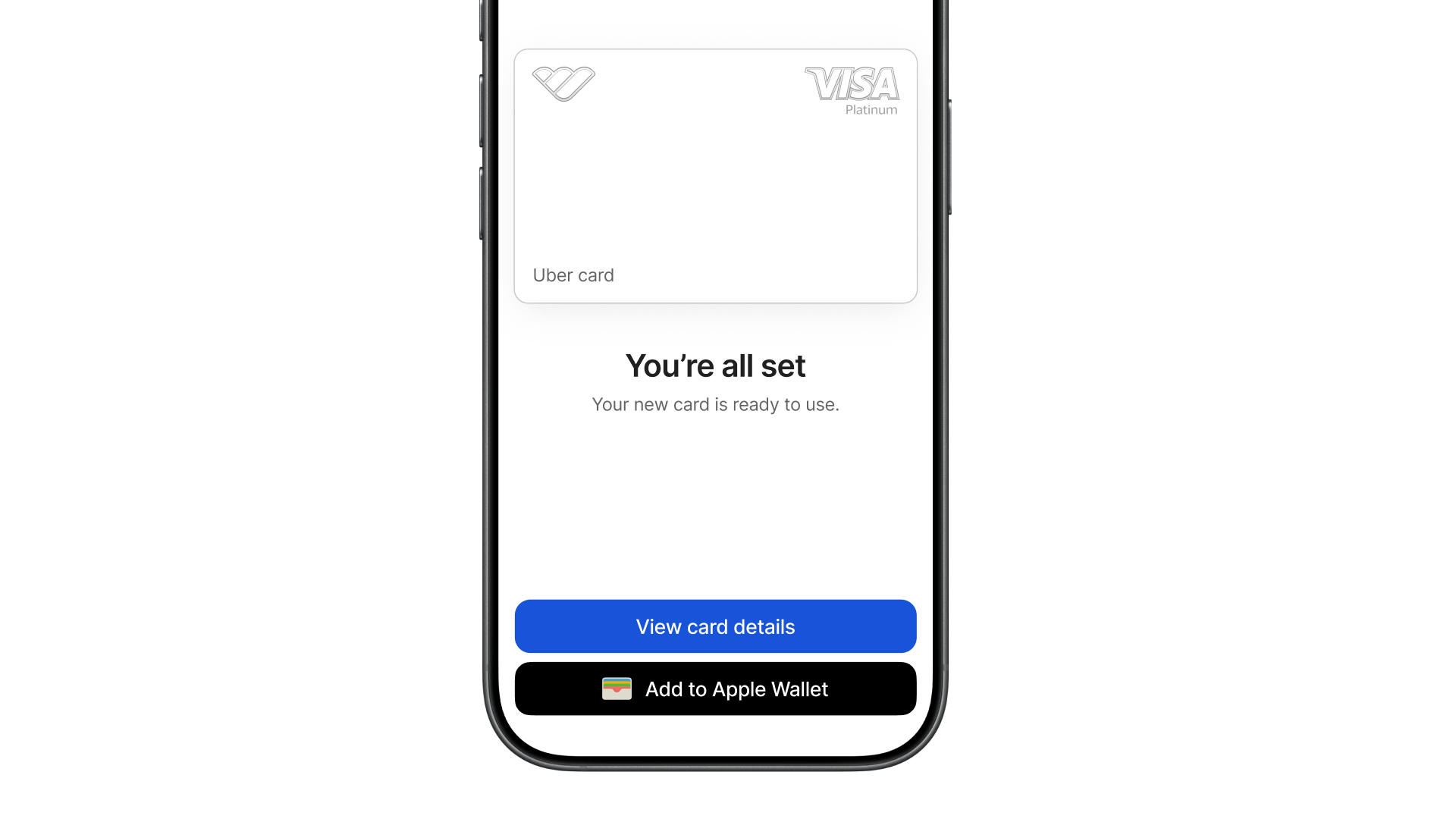
Poke, an AI assistant, issues Whop-powered virtual Visa cards to its human 'Poke Human' virtual assistants – real people behind the AI, who handle tasks like booking a restaurant or reserving a ride on the user's behalf. Each VA gets a virtual card, spending directly from a Whop balance, with spending controls set and every transaction tracked.
Embedded banking/payouts
Embedded banking lets a business, or the people working through it, manage balances and withdraw funds without opening a separate bank account.
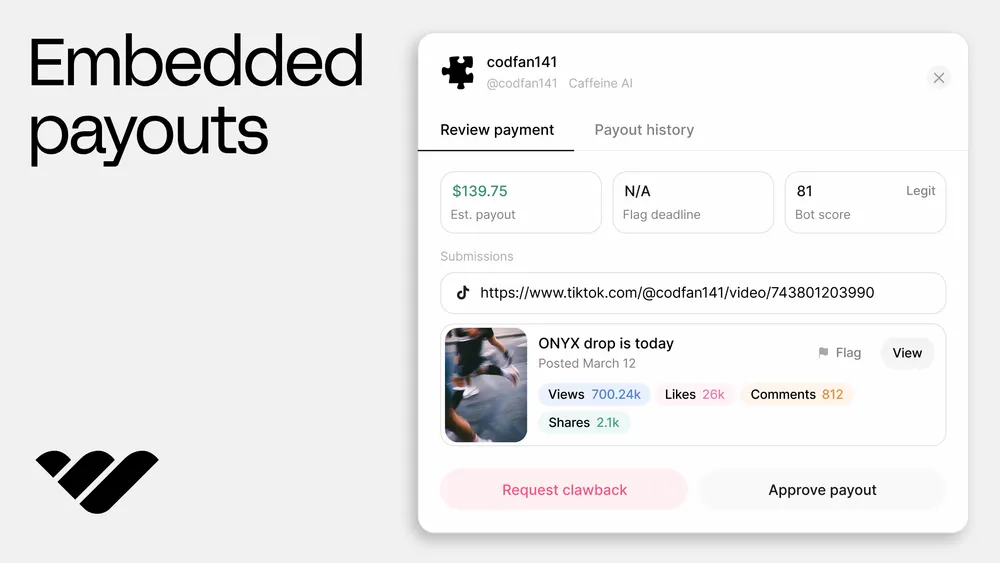
This usually means a business building a payout portal directly into its own product. This portal acts as a place to view an available balance, request a withdrawal, and track past payouts.
FoodFluence embeds payouts with Whop
FoodFluence is a UGC platform that connects restaurants with local food creators across more than 700 cities and 50,000 creators. Before switching to an embedded model, payouts ran across multiple providers.
"Prior to Whop, any other solution we had tried was predominantly just a broken flow where we'd be billing on one platform, then transferring the funds to our bank, and then using another payout provider."
- Branson Packard, FoodFluence CEO
Now, with embedded payouts, creators can view their balance, request withdrawals, and track payout status entirely inside FoodFluence's own platform.
Embedded lending
Embedded lending is the category with the most consumer visibility right now, as 'pay in 4' options have become close to expected at checkout for a lot of purchases.
With embedded lending – specifically BNPL – the financing partner extends credit and takes on the repayment relationship with the customer, while the business gets paid upfront.
Since many BNPL providers aren't licensed banks themselves, BNPL is usually blended with a BaaS model behind the scenes. Hannah Duncan speaks to this point, saying:
"That creates an entire ecosystem where a bank is buried deep in the process, underneath a full stack of technology partners — usually with the consumer having no idea they've transacted with a bank at all. The bank is the only party with the actual authority to issue credit, but under BaaS, it effectively lends out that license, letting everyone above it in the stack screen customers and issue funds on its behalf. What looks like a single click to the customer is really just the tip of the iceberg."
- Hannah Duncan, Financial Journalist
Pinnacle Northwest offers embedded lending with Whop
The trade business offers BNPL on larger jobs, letting clients split a renovation into installments. Getting set up took no coding at all: financing options simply appear at checkout once a business is approved.
Owner Daniel Petrovskiy has noticed it does more than just convert sales: it builds trust even when clients don't use it.
"It solidifies the company a little bit more. When you have something fast and easy to go through, people appreciate that."
- Daniel Petrovskiy, Pinnacle NW
Embedded insurance
Embedded insurance is offered at the moment of a related purchase, e.g., trip insurance offered when booking travel (Booking.com does this), or product protection offered at checkout on a retail purchase.
As Hannah Duncan explains:
"Online customers have been able to instantly insure products and services at the point of sale. This involves a lot of rapid data processing. The insurer needs to measure the risk of both the product and the person to make a compelling offer, while also accepting financial transactions."
- Hannah Duncan, Financial Journalist
Tesla embeds insurance at the point of sale
Tesla is one distinctive example of embedded insurance, as it offers its own insurance directly at the point of sale in a growing number of US states.
Embedded wealth/investing
Embedded wealth means micro-investing or round-up savings features built into an app the customer already uses daily, rather than requiring a separate brokerage account – a shopping or payments app rounding up a purchase and investing the spare change is an example of this in action.
This is the smallest and least mature category covered here, but worth knowing about as embedded finance continues to expand into new corners of everyday spending.
How does embedded finance work?
Now that you understand the layers and key players of embedded finance, let's take a look at embedded finance in action, using that same Lyft example again.
- A driver signs up for Lyft Direct. Payfare (the BaaS layer) runs identity verification and KYC checks against the compliance rules set by Stride Bank (the sponsor bank). A key point: these are not Payfare's own rules, since the bank is the one ultimately liable for who's allowed to hold an account.
- Stride Bank opens the account on its own ledger. This is the step that requires a banking license. Payfare and Lyft never touch it directly.
- The driver completes a ride. The fare is collected from the passenger through Lyft's own payment processing (a separate flow, unrelated to Payfare).
- The driver's earnings route to their Lyft Direct account. Payfare's technology handles the transfer, moving funds over the banking rails Stride Bank has access to (ACH or faster real-time rails, depending on the setup).
- The driver spends from their card. When that happens, the transaction clears through Stride Bank's card network membership (via Mastercard, in Lyft Direct's case). Again, this is infrastructure only a licensed bank can access directly.
- Everyone gets paid for their part. Stride Bank earns through account fees, a share of interchange every time the card is used, and possibly interest on held balances. Payfare earns a technology/platform fee for running the infrastructure connecting steps 1, 2, 4, and 5. Lyft doesn't earn a direct fee here, but its payoff is retention and a better product for drivers, which is why it's willing to absorb the cost of offering Lyft Direct at all.
The whole flow feels instant to the driver, but in reality, it's three companies handing off responsibility to each other in a fraction of a second.
Benefits of embedded finance, layer by layer
We've covered the three layers of embedded finance and how they work together. The next question is simple: what's actually in it for each one?
Here are the benefits of embedded finance, broken down by bank, provider, and brand.
Sponsor bank
The sponsor bank (or banking partner) takes on the lion's share of risk, so why would they choose to get involved with embedded finance? Because sponsor banks report earning more than half of their total revenue – 51.3% – from their embedded finance partnerships, according to Alloy's 2024 State of Embedded Finance Report.
The sponsor bank gets new deposit revenue without having to build or market the product themselves – the end-brand does the customer acquisition, the bank simply provides the licensing. Fifth Third Bank saw deposits tied to its own embedded finance platform grow by $2.1 billion in a single quarter, with fee revenue up 35% year-over-year.
Embedded finance also gives sponsor banks access to customer segments that the bank couldn't reach directly. Think about it: niche platforms, younger demographics, and emerging industries are growing, and these are all areas that a traditional bank has no natural inroad to.
"Customers will be able to access banking services through trusted brands and digital experiences, while banks provide the regulated infrastructure behind the scenes."
- George Toumbev, CCO at NatWest Boxed, in conversation with FinTech Global
Even though these markets stay invisible to the bank's own customers, becoming an embedded finance layer still gets them access.
To put it simply, the sponsor bank gets diversified revenue beyond traditional lending and deposit spreads, at a time when banks are increasingly under pressure to find new income streams.
And as an added bonus, the added revenue from new deposits and new customer segments comes with a lower cost of growth. Someone else is running the marketing, UX, and customer relationship; the bank just supplies the infrastructure and collects fees.
BaaS provider
Like the sponsor bank layer, increased revenue is also a key benefit for the BaaS provider. The BaaS provider can monetize through fees, revenue share, or licensing, and it gets paid for the infrastructure without having to own the end-customer relationship.
It also scales horizontally: one BaaS provider can power many different end-brands at once. Payfare, for instance, powers instant-pay products for Uber and Lyft simultaneously, and Marqeta has powered card products for companies as different as Square, Klarna, and Ramp, all running on the same underlying infrastructure. If you're a provider for one, you can be a provider for many.
Plus, when it comes to brand identity and value, a BaaS provider is positioned as a one-stop infrastructure layer, which can lead to stickier, longer-term contracts with both banks and end-brands.
End-brand
A big benefit for the end-brand using embedded finance is – you guessed it – increased revenue.
With embedded finance, end-brands get a new revenue line that isn't tied to the core product or subscription revenue, by capturing a share of the interchange, financing fees, or transaction fees that would otherwise go entirely to an external processor, card issuer, or lender.
There's also the same 'stickiness' here that benefits BaaS providers. Once a customer's money lives inside your platform – whether that's through a saved balance, an active financing plan, or a card tied to your app – leaving your platform isn't as simple as just trying a competitor. They'd have to withdraw funds, cancel a card, or wait out a repayment term first. Doing all that is annoying, and not having to do that is what keeps them around.
As Weavr CEO and co-founder Alex Mifsud put it in his embedded finance opinion piece:
"Users stay longer because their workflows are complete – not because they’ve been locked in, but because they’re getting more done with less hassle."
- Alex Mifsud, Weavr CEO
Customer experience improves, too, as there are fewer redirects, fewer third-party logins, and less friction at the moment of payment or financing.
"Now our creators can start earning with a lot less friction, which makes the platform a lot easier to use and the experience a lot better."
- Drew Levin, Sideshift CEO
And it's not just that embedded finance works for revenue and retention. It's also that most platforms haven't tried it yet. According to Adyen's 2025 report, less than 20% of the addressable embedded finance opportunity for platforms has been captured so far.
So the platforms that introduce embedded finance now are choosing early, not late.
Are there any risks with embedded finance?
Yes, but this mostly sits with your bank and BaaS partners, not you directly. The risk that does land on you is more about choosing the right partners than about compliance paperwork.
The first thing to know is that regulatory scrutiny on the partners you depend on can still disrupt you. Platforms aren't usually the direct target of enforcement action, but more than a quarter of the FDIC's enforcement actions in 2024 targeted sponsor banks involved in embedded finance partnerships. If your bank gets hit, your product can get disrupted even though you did nothing wrong.
There's also a second risk: limited visibility across partners can slow down problem-solving. Each embedded finance layer typically keeps its own separate systems and its own ledger – the platform sees its side of a transaction, the BaaS provider sees their side, and the bank sees theirs. There's no single shared, real-time view that all three can check at once.
When something goes wrong, each party can only see their own piece of it, and has to wait on others to confirm what happened. This is exactly what made the Synapse collapse so hard to untangle.
Aaron Holmes, CEO of Kani Payments, spoke to FinTech Global and pointed to the collapse of Synapse as an example of why transparency matters:
“Synapse collapsed with a customer shortfall between $65m and $95m, and the root cause was pooled accounts with no independent source of truth. That is a reconciliation failure, not a lending failure.”
- Aaron Holmes, CEO of Kani Payments, in conversation with FinTech Global
Yes, embedded finance comes with risk. But the risk isn't 'should we offer embedded finance,' it's 'who do we build it with'.
Lowering your risk as a platform means vetting a BaaS provider and sponsor bank's stability. Track record matters as much as the product features they offer. Read our list of best embedded finance companies.
The future of embedded finance
Looking forward, embedded finance is quickly moving from feature to infrastructure. Rather than layering financial tools onto an existing product as an add-on, more platforms are architecting the product around them from the start.
Personalization is on the horizon, too. Transaction data is increasingly being used to adjust rewards, credit terms, or offers in real time based on customer behavior, rather than offering the same static financial product to everyone. Synchrony, one of the largest providers of embedded credit card programs, saw a 7% increase in conversion rate for card applications after personalizing offers to individual customers (Mastercard case study).
This isn't a slow-moving change. Embedded finance adoption isn't just on its way – it's already here. A 2025 survey of 515 director-level decision-makers across banking, fintech, HR, retail, and technology found 99% have already adopted some embedded finance capability, with payments and banking the most common (Green Dot, Feb 2026).
So, that 'less than 20% captured' opportunity from the benefits section isn't going to stay open indefinitely. Near-universal adoption among decision-makers signals that the window to be an early mover is closing, not opening further.
Want to bring embedded finance to your platform? Build it with Whop
Ready to bring embedded finance to your platform?
With Whop, you can embed checkout directly into your product (and offer BNPL as a payment option), give your users a payout portal to manage their balance and withdrawals without leaving your platform, and issue virtual cards – all without becoming a bank, lender, or issuer yourself.
Cal.com, Nickel, Poke, FoodFluence, Metafy, and Replit are just some of the platforms already running on Whop's embedded components. Are you ready to join them?
Embedded finance FAQs
What is embedded finance and how do companies use it?
Embedded finance is a financial product (a payment, a loan, a bank account) offered by a company that isn't a bank, built directly into a platform customers already use. Companies use it to keep transactions on-platform instead of redirecting users elsewhere, which increases conversion and opens up new revenue that would otherwise go to a third party. Platforms like Cal.com use embedded finance providers like Whop to embed payments directly into their app.
What's the difference between embedded finance and BaaS?
Embedded finance is what the customer experiences, which is the financial product itself. BaaS is how the product is powered – meaning the licensed infrastructure behind the scenes.
How do I add financial services like payments and payouts into my own product?
By using an embedded finance provider (like Whop) that gives you pre-built components for checkout, payouts, and card issuance. This means you're building on top of existing infrastructure rather than negotiating separate bank and compliance relationships yourself.
Which company should I use to add embedded finance to my platform?
It depends on what you need. Some providers hand you raw infrastructure and expect you to build the product layer yourself. Others, like Whop, package payments, payouts, and financing into one ready-to-use stack. The right choice for you comes down to API quality, compliance coverage, and how much you want to build yourself.
What are the best embedded finance providers?
Whop, Stripe, Adyen for Platforms, Marqeta, and Unit are among the most established. Whop stands out for platforms that want payments, payouts, and financing packaged together out of the box.



![Top 14 best global payout platforms [2026] for cross-border payments](https://storage.ghost.io/c/12/7b/127b828b-bdc2-4972-9cf2-de857df9c324/content/images/size/w1000/format/webp/2026/08/blog-best-global-payout-platforms.png)
![Top 10 best embedded finance companies for SaaS and marketplaces [2026]](https://storage.ghost.io/c/12/7b/127b828b-bdc2-4972-9cf2-de857df9c324/content/images/size/w1000/format/webp/2026/08/embedded-finance.jpg)